

Whitepapers
To Observe or Act? Leading GenAI Transformations from the Front
As GenAI capabilities become more accessible, many companies remain on the fence. According to a BCG report, 90% of executives are still in the “observer” phase, either waiting out the hype or conducting limited pilots. This hesitation is understandable, with only 15% of leaders seeing significant GenAI value in their EBIT, according to McKinsey. However, waiting in the wings only ensures remaining in the other 85%. Leaders who act now with conviction can seize a competitive advantage by prioritizing the right domains and driving forward with conviction.
Domain Prioritization
As generative AI technology advances, leaders face a double-edged sword: countless opportunities emerge, but the challenge lies in knowing which to prioritize. In a recent interview, Microsoft President Kevin Peesker emphasized the need to be “deliberate with intent” when navigating these opportunities. Peesker shared how his team first implemented GenAI in their 30,000-person support organization and customer-facing go-to-market teams—two high-impact domains that drive material customer experience improvements and financial value. Reflecting on his organization’s own transformation journey, Peesker emphasized the importance of focusing on two or three domains, not ten or fifteen, to drive deliberate action, focus, and tangible results.
To this notion, McKinsey & Company’s Rewired (by Eric Lamarre, Kate Smaje, and Rodney Zemmel) offers a valuable framework for domain evaluation in its chapter Choose the right transformation ‘bite’ size. The chapter discusses how once potential domains are identified, they should be assessed along two dimensions: value potential and feasibility (demonstrated in figure 1). Value can be measured by factors such as customer experience, financial benefits, and synergy with other domains (e.g., the ability to reuse data, technology, or change management efforts across the organization).
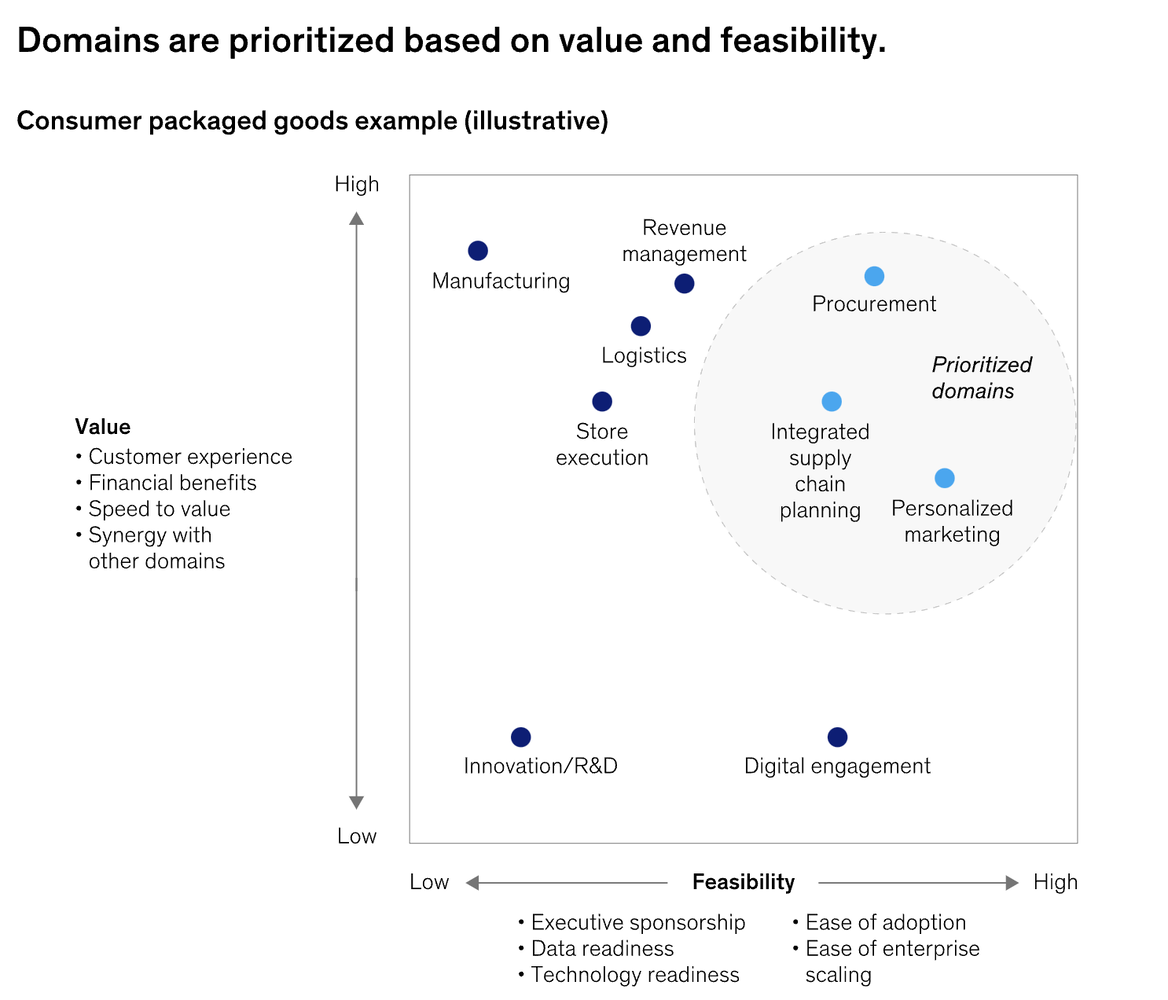
From a feasibility perspective, leaders must assess whether their organization has the necessary technical, data, and talent resources to drive meaningful change. As outlined in Rewired, this includes:
- Executive sponsorship and commitment for domain transformation.
- Data Readiness—often one of the biggest barriers we see. A recent AWS study showed only 11% of data leaders strongly felt their data was GenAI-ready.
- The right mix of technical capabilities, both off-the-shelf and proprietary.
- The ability to drive internal adoption seamlessly.
- The ease of scaling capabilities within the Enterprise.
Collaboration and Shared Accountability
One of the most critical factors in any AI transformation is a leader’s ability to drive collaboration and shared accountability across departments. In a recent Fortune article, McKinsey’s Global Head of Digital, Rodney Zemmel, discussed benchmarking 50 large banks, where only 25% realized significant value from their AI or digital investments. The key factor wasn’t investment size or technology architecture, but how well business and technology teams collaborated. Instead of getting distracted by choosing between GPT-4o or GPT-4, leaders should focus on building the right Transformation Team and fostering collaboration and shared accountability.
The Transformation Team should consist of top players from various organizational domains, capturing different expertise and institutional knowledge that might otherwise be lost. While collaboration may seem straightforward, it’s often challenging in large corporations. Take data, for example—the lifeblood of any GenAI capability. Data access is far from simple. First, you must identify who owns the data, ensure they are aligned with the transformation effort, assess its quality, secure privacy and compliance approvals, and agree on a consistent customer model, which often varies across departments. If multiple departments’ data sets are required, this process needs to be repeated—underscoring why collaboration and alignment are critical from the start.
Driving shared accountability from the top down helps bridge alignment gaps. To ensure the Transformation Office is aligned and working toward a shared vision, organizations should:
- Have CEO-Sponsorship: The CEO’s role is crucial to driving successful AI transformation outcomes. As the central figure, the CEO can break down silos, set the vision, and signal the initiative’s importance to the entire organization. A great example is Jamie Dimon of JP Morgan, who has compared AI’s potential to the steam engine. Dimon has already rolled out GenAI capabilities across various domains, from client-facing tools like IndexGPT to internal solutions empowering over 50,000 employees with advanced research capabilities.
- Speak the Same Language: Leaders from different departments often have varying understandings of core concepts and differing perspectives on transformation. It’s crucial to establish a common understanding of concepts and capabilities. McKinsey’s Rewired suggests starting the transformation with an experiential leadership learning journey, requiring at least 20 hours per executive. This includes visits to companies further along in their digital journeys, executive training, and “art-of-the-possible” workshops.
- Provide Amnesty: GenAI transformation efforts are bound to encounter roadblocks from historical business, technology, and data decisions. Executives often build their careers on rolling out high-profile programs or choosing specific technologies and architectures. Hindsight is always 20/20 and if these past decisions prove to be wrong or just out of date based on the rapid advances over the last few years, it’s crucial to apply corporate amnesty to lower defenses and focus on the forward-looking transformation. However, this amnesty comes with a condition: if anyone starts pointing fingers, passing blame, or fighting about previous decisions, they are off the Transformation Team.
With so many organizations still in the “observer” phase, the opportunity for action is clear. The companies that prioritize the right domain “bite size” will emerge ahead. As leaders, the temptation to take on too many initiatives can dilute impact. But by fostering collaboration and shared accountability, while executing a few targeted, domain-driven transformations, the potential for meaningful, scalable success is within reach. Beyond the short-term value that GenAI pursuits can deliver, the long-term operational discipline and institutional knowledge gained will serve as a competitive advantage when observers decide to join the race.

Rab Bruce-Lockhart
Chief Revenue Officer
15:16 – 26th January 2025
Ready to discover more?
Contact us and we’ll set up a video call to discuss your requirements in detail.